Within the
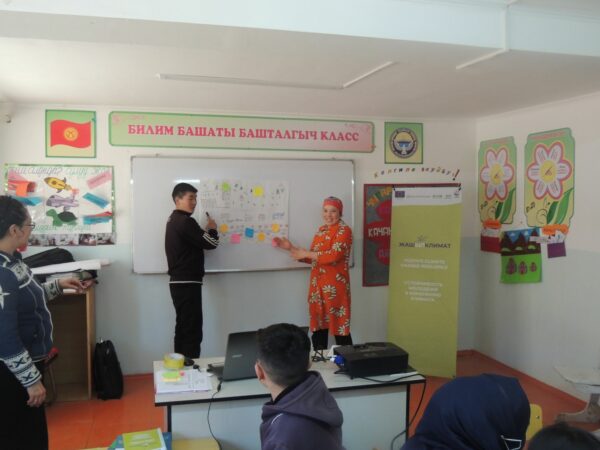
#JashylKlimat Project, an inception workshop was held on 22 February 2022 in the village of Oruk-Tam, Naryn region.
This remote village is set among the mountains and is hard to reach.
During the meeting the Project experts introduced the participants to the goals and objectives of the project, as well as to the ways of adapting to climate change and its impacts.
To assess the vulnerability of the local community to climate change and to compile a “radar” of the village of Oruk-Tam, a survey was carried out using a purpose-designed method.
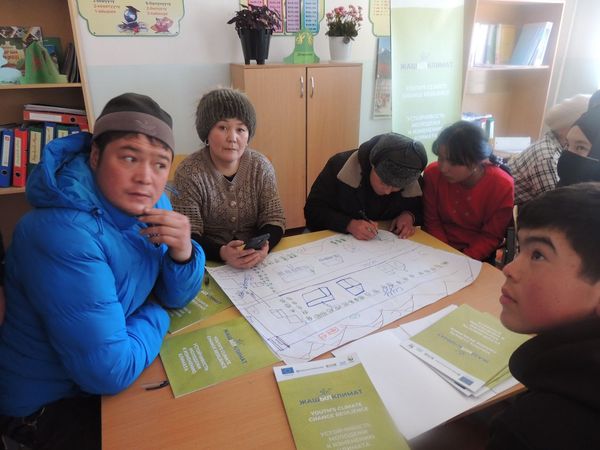
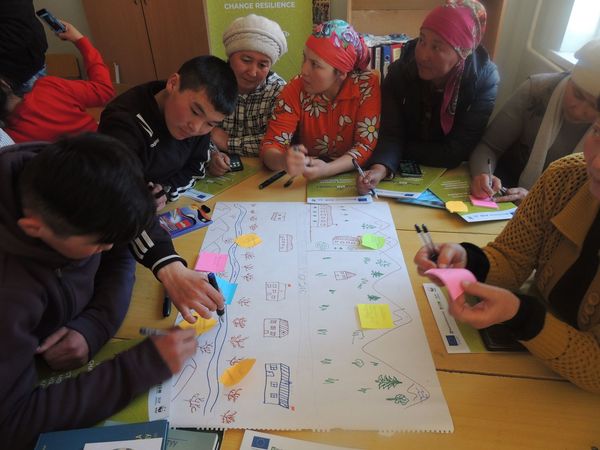
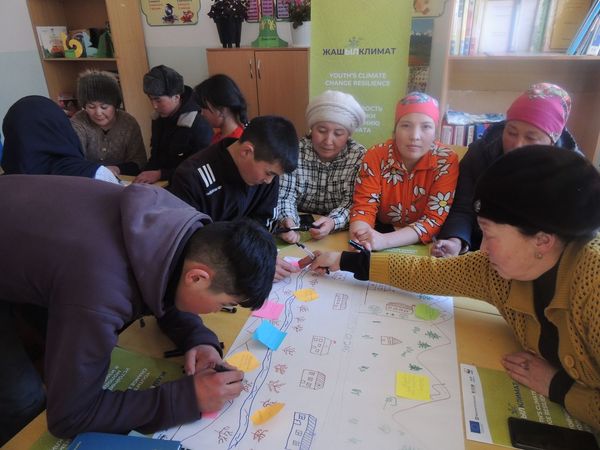
To identify existing problems related to climate change, mapping was carried out in two groups. The groups drew up a map of the village, marking ecosystem services, cultural and recreational sites, the factors that regulate and support the ecosystem, and also the zones, factors and risks of natural disasters.
During the presentation of the map the participants actively added to the presenters’ work and made their own corrections and additions.
The participants also reported that three years ago the village youth committee decided to introduce a moratorium on hunting in the vicinity of the village, both for local residents and for visitors. As a result, roe deer, which had been wiped out in previous years, have begun to appear around the village again.
As a result of the meeting the following problems were voiced:

pasture degradation;
pollution of pastures with wool from sheep brought in from the valleys — because there is no processing and no demand for it;
after shearing, the shepherds either leave the wool on the pastures or burn it,
unemployment, the lack of alternatives to livestock farming, the need to move from the quantity of livestock to quality, and so on.
By occupation, the participants included farmers, teachers, local self-government officials and a youth initiative group.
_______
The project “Youth Resilience to Climate Change” is funded by the European Union
European Union in Kyrgyzstan. The project is implemented under the overall coordination of the Norwegian Society for the Conservation of Nature
Naturvernforbundet in partnership with the Ecological Movement “BIOM” and the Public Association “GLIP”.