Labour migration is an important social phenomenon for Kyrgyzstan. According to various estimates, more than 1 million citizens of Kyrgyzstan are currently working abroad as labour migrants. Today’s realities point to the need for our compatriots to have a sufficient level of education and key skills in order to be competitive on the international labour market, and to the need to develop a national qualifications system.
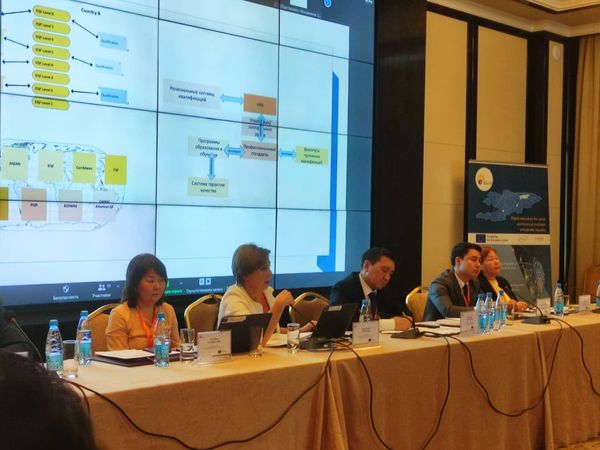
On 25 November 2021 the international conference “Promoting policies of financial, social and digital
inclusion and gender equality for young migrants of Kyrgyzstan” was held, organised by the project “E-QUALITY: digital education for social and financial inclusion and gender equality, implemented in the Kyrgyz Republic” with the support of the European Union.
Svetlana Sirmbard, head of the expert group, noted that the main goal of the “E-QUALITY” project is to develop new skills of digital literacy, entrepreneurship and leadership among socially vulnerable groups in the Kyrgyz Republic, such as young migrants (including young women) with low qualifications, by creating and promoting a sustainable model of social inclusion.
The conference participants noted the importance of developing the key skills of young migrants from Kyrgyzstan and of applying modern practices in education in order to raise the level of qualifications. The experts emphasised that highly qualified specialists are currently in ever greater demand on the market.
Experts from Kyrgyzstan spoke at the event, as well as international experts from Bulgaria, Latvia and Russia. They shared international experience of training and adapting labour migrants in their countries, and also the professional requirements for foreign specialists.
Anna Kirilenko, manager of the EU project “Jashyl Klimat”, spoke about the importance of “green” skills for successful employment and the social adaptation of migrants.
The project “Jashyl Klimat — Youth Resilience to Climate Change” is implemented under the overall coordination of the Norwegian Society for the Conservation of Nature, in partnership with the Ecological Movement “BIOM” and the Public Association “GLIP”, with the financial support of the European Union.