On October 8, the UNDP office in Bishkek hosted an open meeting with internationally renowned scientists — Anastasia Makarieva, Candidate of Physical and Mathematical Sciences, and Andrei Nefiodov, Doctor of Physical and Mathematical Sciences and Professor, developers of the concept of biotic regulation of the environment.
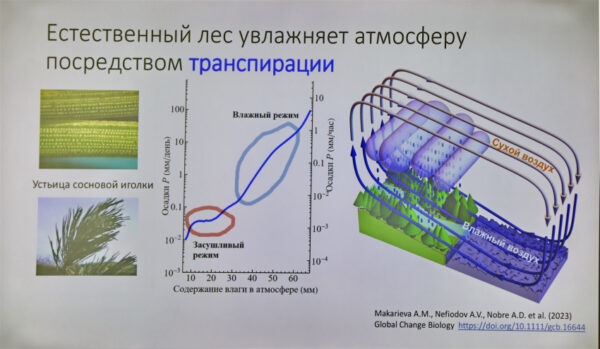
The core idea of biotic regulation, developed by Professor V.G. Gorshkov and A.M. Makarieva, is that living nature is not a passive victim of climate change but an active regulator of the state of the atmosphere, the water cycle and the planet’s energy balance. Living organisms, in the form of natural ecosystems, do not simply adapt to the environment — they actively shape and maintain the stable conditions necessary for life. This approach radically differs from traditional views, in which nature is seen as a passive object and changes in the environment as the result of external physical or chemical factors. Ecosystems as self-regulating systems. Living organisms (primarily vegetation) control key environmental parameters, including atmospheric composition, temperature and the hydrological cycle. Biotic regulation is a global process in which ecosystems function as a self-regulating system, preventing extreme changes and ensuring the stability of the biosphere.
The event was organized by the BIOM Ecological Movement with the support of the United Nations Development Programme (UNDP) in Kyrgyzstan. Ecologists, biologists, teachers, representatives of public organizations and experts attended the meeting. In an open dialogue format, participants discussed fundamental questions about the relationship between climate, biodiversity and ecosystem functioning in the context of planetary sustainability boundaries.
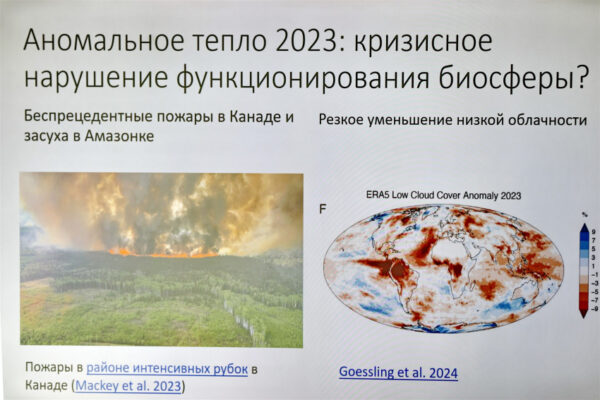
A separate part of the meeting was devoted to the situation in Kyrgyzstan and Central Asia, where the effects of climate change are felt especially acutely — melting glaciers, more frequent droughts, biodiversity loss and depletion of water resources.
According to participants, biotic regulation approaches could become a new scientific basis for ecosystem restoration programs, water resource management, and adaptation of rural regions to climate challenges. UNDP representatives noted that such dialogues between international scientists and local specialists help strengthen the scientific basis of environmental policy and foster an interdisciplinary approach to environmental research.
Key postulates: Life itself (the biota) creates and maintains the optimal environment. Life compensates for unfavorable deviations of the environment from the optimum. Life creates the conditions for life! It is commonly believed that organisms adapt to the environment, but the theory of biotic regulation points out that living systems themselves shape and maintain the conditions necessary for their own existence. For example, forests regulate temperature, humidity and atmospheric composition, creating favorable conditions for many species, including humans. From the standpoint of biotic regulation, wild nature is viewed as a critically important element for maintaining climate stability.
Scientists are convinced: preserving natural ecosystems is a key condition for stabilizing the climate and preventing global catastrophes. During the lecture and discussion, experts stressed that it is precisely the continuity of forest, meadow and other natural ecosystems that ensures moisture circulation and shapes a stable climate. The destruction of natural landscapes, conversely, weakens biotic regulation mechanisms, dries out territories and intensifies weather extremes.
At the end of the meeting, participants discussed the need to change public perception of nature’s role: not as a raw-material resource, but as the regulator and shaper of our shared Living Environment — a complexly organized living organism of which we are a part, and on which the climate stability of the planet directly depends. “When we talk about climate, we must remember — it is not regulated by machines and not restored by technology. Life itself does this. Our task is not to get in its way,” emphasized Anastasia Makarieva.
The organizers expressed hope that such events would become regular and would help unite the efforts of the scientific community, environmental organizations and government structures to protect Kyrgyzstan’s natural ecosystems.

More about the concept of biotic regulation of the environment on the Telegram channel @bioticregulation