“We are destroying that without which we cannot survive”, — these famous words belong to the renowned Kyrgyz scientist, Emil Dzhapparovich Shukurov. Today we invite you to learn more about ECOSYSTEMS by watching a wonderful ANIMATION from the BIOM Ecological Movement, based on the works of E.J. Shukurov.
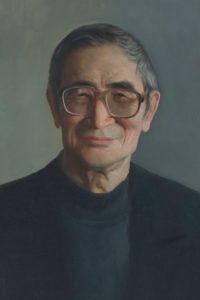
“Life is not a property of an individual organism, but a property of the biosphere as a whole. Natural ecosystems reproduce the matrices of life. Nothing created by man is capable of replacing the biospheric function of natural ecosystems. Everything created by man is several orders of magnitude simpler than the most primitive living system. …Ecosystems have taken shape over many millennia…”
Prof. E.J. Shukurov.
There are no “solitary” species in nature. The life of every living creature unfolds in interaction with a multitude of other living creatures.
A complete picture of the country’s animal world cannot be achieved without studying the patterns of distribution and abundance of animals, and their attachment to and inclusion within particular ecosystems.
(Zoogeography of Kyrgyzstan. Shukurov E.J. – B.: 2016)
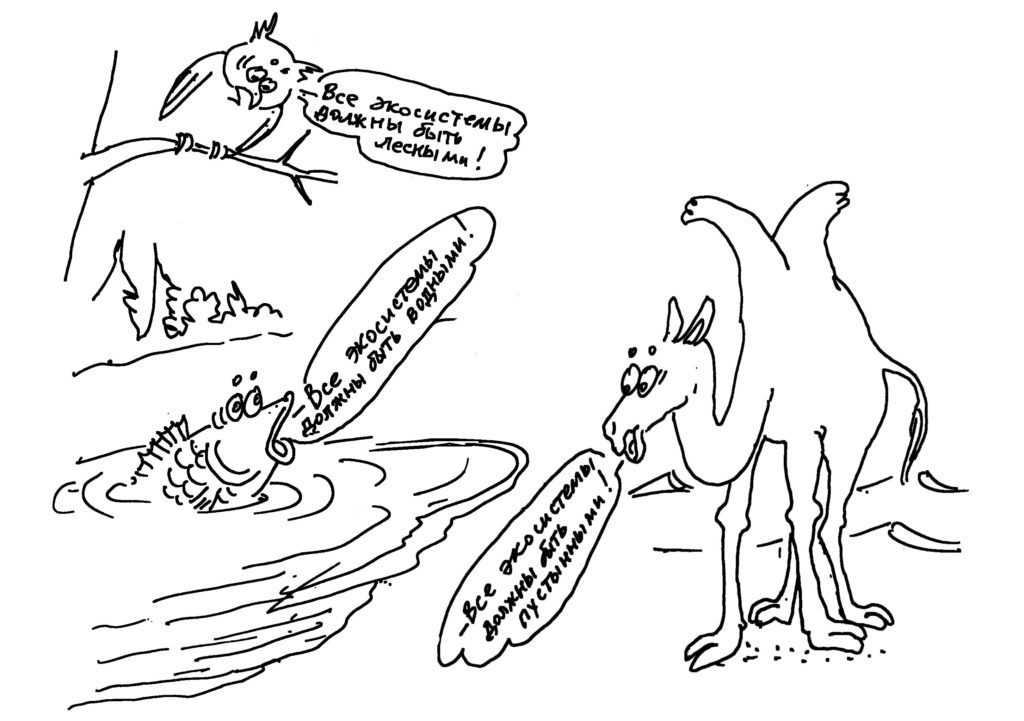
Drawing by E.J. Shukurov
The smallest unit of life is the natural ECOSYSTEM. And the simplest natural ecosystem consists of many thousands of species, of many billions of organisms (hard to imagine, but a single handful of soil contains several billion living creatures, even if they are microscopic!), working together harmoniously to sustain the great cycle of Life in every corner of our planet.
Natural ecosystems form a favorable habitat for living organisms and provide the conditions for sustainable development, because it is Life that creates the conditions for Life! Each type of ecosystem can be seen as a foundation that sustains Life itself, and therefore the entire system of our society.
(Shukurov E.J., Korotenko V.A., Kirilenko A.V. et al. Environmental Security in the Context of Sustainable Development of Kyrgyzstan. – Bishkek, 2015)
THE ANIMATED GUIDE TO ECOSYSTEMS was developed by the BIOM Ecological Movement based on the works of E.J. Shukurov as part of a project of the Food and Agriculture Organization of the United Nations (FAO), “Information campaign for the youth of the KR on sustainable natural resource use, climate change and integration into the UN Global Youth Alliance (YUNGA)”.
WHO IS THIS ANIMATION FOR? — For schoolchildren, students, and anyone who wants to understand which species make up a given ecosystem.
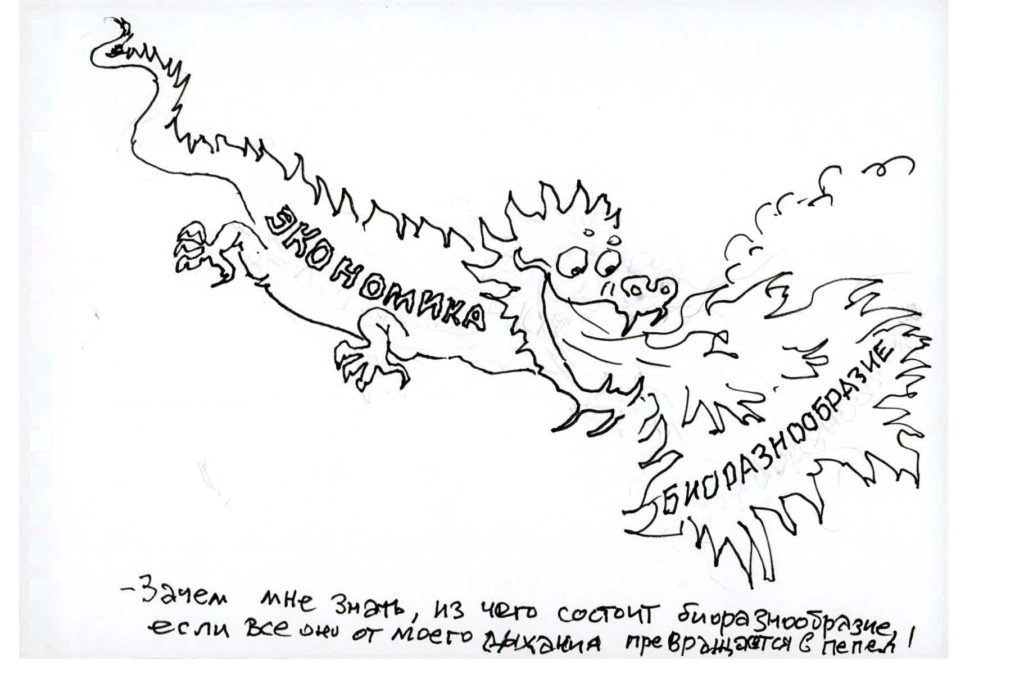
Drawing by E.J. Shukurov
“We still do not have sufficiently complete descriptions of the main features of ecosystem ‘faces’. These ‘portraits’ are only first sketches, but they nonetheless show the complex structure of each ecosystem and allow us to picture a coherent, actually functioning community.”
“Simplification is akin to death”
We live in a simplifying world. Moreover, in a world becoming ever more primitive. What’s wrong with that? The problem is that the good in such a world becomes ever worse. Life is being replaced by degeneration. For the worse hinders the return, the rebirth, of the good.
In our mountains, in the past century, in some places grasses concealed a horseman completely. Wild animals were a constant neighbor to humans. Now the emptied landscapes have forgotten the abundance of flowers, butterflies and birdsong. Just as they have forgotten truly folk festivals and melodies.
“The great wheel of Life turns on the edge of non-being, overcoming the powerful resistance of inert forces, and therefore Life must possess an enormous margin of strength and flexibility. Such strength and flexibility are given to it by numerous species which, taken separately, cannot withstand dead nature, but together are able to sustain the relay of Life on Earth…”
(R.N. Ionov, E.J. Shukurov. An Assessment of the Main Ecosystems of the Western Tien Shan. – Bishkek, 2003).
Spruce forests are remarkable ecosystems that serve as a guarantor of safety and a factory of life on mountain slopes.
Thanks to their rich plant world and dense cover, these forests intensively evaporate moisture, thereby lowering the temperature of the atmospheric air. Through this physical process in the atmosphere, atmospheric moisture concentrates above coniferous forests and falls as precipitation. Thanks to coniferous forests, mountain rivers are replenished with moisture.
Mountain slopes where coniferous forest grows are less subject to erosion. It is important to know that mountain coniferous forests take a very long time to recover — they grow very slowly, and artificially planted trees take root with great difficulty, making it practically impossible to plant a coniferous forest.
Therefore it is unacceptable to destroy our mountain coniferous forests for timber! The momentary benefit of the timber will never pay off the benefit the forest provides to the whole country.
(Shukurov E.J. Sh–95 Nature. Culture. Man. Selected Essays. “Taalim-Forum” Public Foundation, EDK Aleine. – B., 2013).
Nut-fruit forests are truly a treasury of genetic resources for new varieties of fruit and berry crops. This is a unique corner of our Motherland, which it is important to preserve for future generations, just as our ancestors once preserved it.
“Life is inconceivably diverse because uniformity is akin to death for it. The impoverishment of the species diversity of ecosystems is an approach toward death, non-being. Just as the impoverishment of the diversity of the ecosystems, communities and species themselves. Man, by reducing the diversity of species and ecosystems, replacing them with extremely poor and unstable artificial ecosystems, sharply narrows the arena of Life.”
(R.N. Ionov, E.J. Shukurov. An Assessment of the Main Ecosystems of the Western Tien Shan. – Bishkek, 2003).
“No biological species can normally exist or reproduce without the ecosystem native to it. Therefore any species can only be reliably preserved on the condition that its full parent ecosystem is preserved…
…Life manages to endlessly reuse the same atoms once captured from the non-living environment. And in this way it avoids the accumulation of waste that could destroy life itself.
Human ecological well-being is impossible without preserving the creative power of natural ecosystems. Therefore, protecting nature and individual species without protecting and restoring ecosystems is an empty phrase.”
(E.J. Shukurov, R.N. Ionov, L.P. Lebedeva, E.E. Shukurov, T.R. Ionova, A.A. Zhusupbaeva. Plant and Animal Communities of Kyrgyzstan. B., 2017).
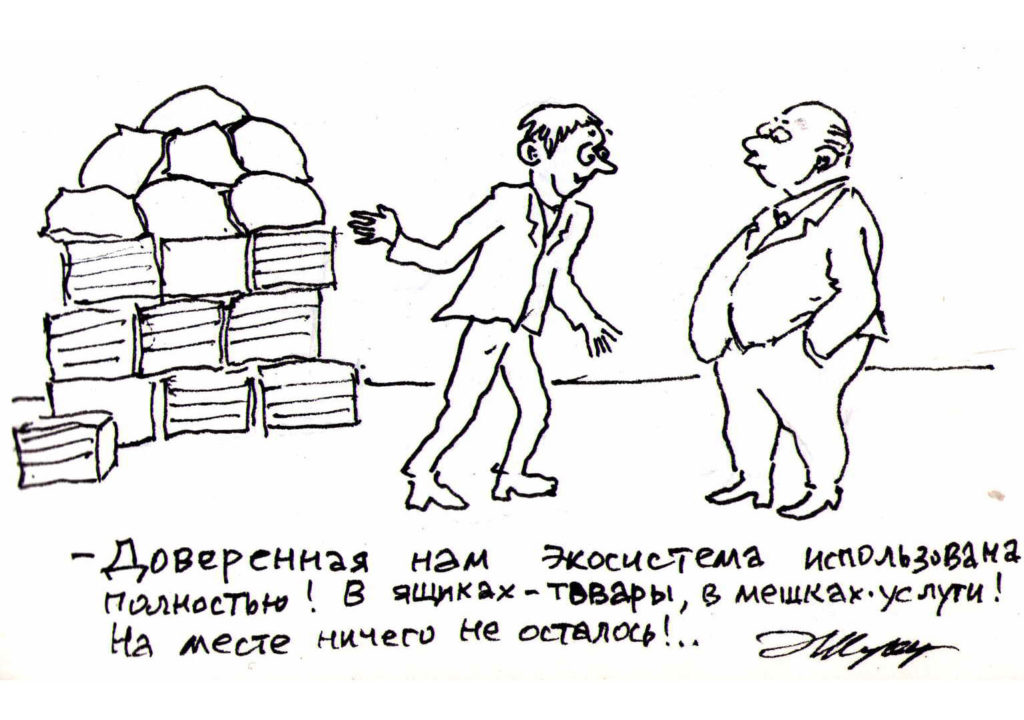
Drawing by E.J. Shukurov
You can watch an animation about natural ecosystems in English and Kyrgyz HERE:
High-mountain ecosystem:
Alpine Grasslands Ecosystem
High-mountain pasture-grass ecosystem (Kyrgyz)