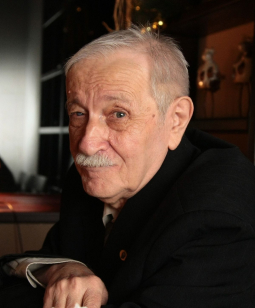
Psychologist, historian, experimenter, legendary philosopher, Doctor of Philosophical Sciences, Professor, Aron Abramovich Brudny was born in the city of Frunze in 1932.
In 1947, he completed secondary school No. 6 in Frunze as an external student.
In 1953, he graduated from the Department of Philosophy of the Faculty of History and Philosophy at Kyrgyz State University, and in 1954 from the Faculty of Medicine at the Kyrgyz Medical Institute, with two honors diplomas.
In 1957, he entered graduate school in philosophy and graduate school in human physiology. In 1960, he defended his dissertation for the degree of Candidate of Philosophical Sciences on philosophical problems of natural science: “Theodor Pavlov’s Theory of Reflection.”
During his work from 1959 to 1998 at the Academy of Sciences of Kyrgyzstan, he defended his doctoral dissertation (1970) on the topic “Language, Consciousness, and Reality.”
The essence of the professional help provided by counseling psychologists can be defined through the categories proposed by L.S. Vygotsky — co-experiencing, and more broadly, co-living through fragments of the client's life, their problems and feelings, the outcome of which can be co-development, co-personal growth, and a growth in cultural co-productivity. Counseling activity can be viewed as psycho-hermeneutic, and its effectiveness largely depends on the nature of the counselor's understanding and interpretation of the material provided by the client. If we accept this position, then in the training of a professional psychologist, one of the main educational goals becomes developing an understanding personality in the professional — one oriented toward working together with another subject to make sense of oneself and to "complete the construction" of one's own meanings.
A psychological study of the 'doppelgänger phenomenon' allows us to put forward the hypothesis that its starting point is a fixation on the 'mirror stage' (per Lacan), which has a very serious and still insufficiently studied significance. An experimental study of individuals engaged in imitation games showed that they performed the 'Draw-a-Person' test in an unusual way: during testing, a duplication of the depicted figures occurred. The authors of the article suggest that this finding may indicate the emergence of new forms of understanding reality in the history of culture.
The decisive force is not participation in production, but the use of its products. This force creates society as an apparatus for the succession of generations. Its essential function is precisely genealogical. Built into the very existence of society is a screen that conceals the actual mechanism of power. The clock metaphor allows us to compare this screen to the dial (public power), and the actual forces of power to the clockwork mechanism.
The subject of this lecture is play from the point of view of psychology. Play is examined as a process which, in terms of behavior, represents a conditional modeling of real-life situations. Play has characteristics such as coupling weight and perimeter, and has a modeling aspect, an important side of which, in life situations, is reflection. Play also presupposes the internalization of rules.
Culture, cognition, understanding, communication, psychology, and the meanings of existence were always at the center of A.A. Brudny's attention. His works occupied, and still occupy, a leading position in understanding the place and possibilities of humankind in the world. This essay, based on Brudny's ideas, examines one of the most pressing problems — culture and the existence of humanity in this world.
The psychology of Kyrgyzstan is best characterized by the well-known aphorism of Ebbinghaus: psychology has a long past but a short history. The folklore and epics of the Kyrgyz people, existing for more than 1,000 years, contain many statements regarding the characterological features of personality, gender and psychological differences, the influence of language on behavior, and so on, but these ideas are not systematized to any significant degree. They attract the attention of language researchers
Consciousness is the existence of our "I," and it is expressed through relation. In other words, consciousness finds expression in the relation of the individual self to that which is, may be, or could have been. It is often claimed that consciousness is a "reflection" of the surrounding world, but consciousness cannot be reduced to reflection at all; rather, consciousness is an illumination of the external world, while thinking is an immersion into the internal and external world.
Magic is studied from a wide variety of perspectives — ethnographic, psychological, and historical-cultural. The author examines magic as a phenomenon of human existence, finding expression in both individual and mass consciousness.
When people speak of the struggle for nature conservation, this is, of course, primarily from a psychological point of view, about — or should be about, if we grasp the essence of the matter — not so much the relationship of humans to nature as the relationship of people to one another. This is something we ourselves do not always realize.
What is the struggle for nature conservation? Some kind of state action? Or is it the activity of some organized group of people? Or something else entirely? We will speak about this third possibility — what it could be, if we were to set ourselves the hypothetical task of achieving this goal. Organizationally: people would gather, they would organize a certain society (such a society does, generally speaking, exist, but we know very well that the mere existence of this society by no means guarantees the conservation of nature, and moreover, this society, at least in part, does not deal with this issue at all). If the struggle for nature conservation is strictly a state action, perhaps not a one-time event but an ongoing one, then it is organized by a body of civil servants — and you, too, are not one of them (in this capacity).