
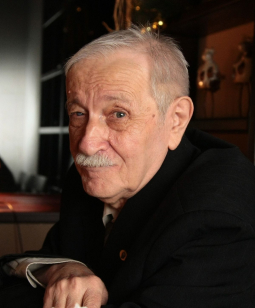
Psychologist, historian, experimenter, legendary philosopher, Doctor of Philosophical Sciences, Professor, Aron Abramovich Brudny was born in the city of Frunze in 1932.
In 1947, he completed secondary school No. 6 in Frunze as an external student.
In 1953, he graduated from the Department of Philosophy of the Faculty of History and Philosophy at Kyrgyz State University, and in 1954 from the Faculty of Medicine at the Kyrgyz Medical Institute, with two honors diplomas.
In 1957, he entered graduate school in philosophy and graduate school in human physiology. In 1960, he defended his dissertation for the degree of Candidate of Philosophical Sciences on philosophical problems of natural science: “Theodor Pavlov’s Theory of Reflection.”
During his work from 1959 to 1998 at the Academy of Sciences of Kyrgyzstan, he defended his doctoral dissertation (1970) on the topic “Language, Consciousness, and Reality.”
Recently there has been a marked increase in psychologists' attention to all forms of behavior that are, in one way or another, connected with money; this is apparently linked to their focus on social processes (for example, buying and selling is directly connected with communication) and to the dependence of the use of money on the personality characteristics of the individual. The work briefly presented below attracted the attention of the organizing committee of the International Congress of Applied Psychology and was included on the agenda of the plenary session, but was not delivered for reasons unrelated to its content.
In a simplified view, communication is a process formed by the activity of its participants. The core of this process is directed connection, which is expressed in the transmission of information. The relationship of the subjects of communication to one another and to its object underlies what can be described as a communicative system. Let me note once again that what has been said is simplified and variable. One can, for example, view the participants in communication as its subjects at different levels of activity; if we see the essence of communication in activity, then the transition to its existence occurs through the choice of its specific forms. Regarding the object of communication, opinions differ: one can see the Other, toward whom the subject's intention is directed, as the object of communication, or one can regard the substantive side of communication — its theme, Umwelt, Mitwelt — in a word, the world that is not indifferent to us — as its object.
The chaos currently observed in the spiritual life of society is the filling of a void — a natural result arising from the removal of rigid ideological pressure. Without going into a detailed account of the laws governing the ideological life of society, let us note that there is no society without social consciousness, and people intuitively feel the need to share certain views, opinions, and interests with others. The stability of this collective sense of self-awareness guarantees the stability of behavioral attitudes and of the individual's social standing. 'Consciousness abhors a vacuum,' and so the elementary constructs that have a long history and deep psychological roots are the quickest to return. This is precisely what we observe in the form of widespread fascinations with astrology, pseudosciences, and religions in their most vulgar manifestations — in short, everything that requires no education or effort to acquire. Such 'fruits of enlightenment' are always followed by the 'reign of darkness.'
We were dining in the basement room of the 'Leningrad,' reportedly the most fashionable evening restaurant in Kyiv. Professor Porshnev presided. Seated around the table, in order, were young psychologists — Andrei Brushlinsky (Institute of Philosophy, USSR Academy of Sciences), Rita Bobneva (Institute of Sociology, USSR Academy of Sciences), and Aron Brudny (Institute of Philosophy, Kyrgyz SSR Academy of Sciences). Given the combination of personalities, we were sitting not so much at a table as on a powder keg ready to explode at one careless word. Everyone in this small circle of candidates and doctors of science was militantly denying something — the work of this or that scholar, this or that psychological school, these or those experimental methods.
These notes are based on conversations with students about the collection 'Psychology, Linguistics, and Interdisciplinary Connections' (eds. T.V. Akhutina and D.A. Leontiev), published in Moscow (Smysl Publishing) in 2008 and devoted to the many-faceted scholarly work of A.A. Leontiev. There were several such conversations, and material published by R. Frager and J. Fadiman in the encyclopedic volume 'Personality' (Moscow, Olma-Press, 2002) is also used here. In essence, the issues discussed here are of known interest to students and teachers, participants in a seminar on the problems of communication. I would like to note that the free form in which the material is presented should not trouble a reader interested in the mutual influence of understanding and communication.
The existence of the world is continuous, and this is quite obvious. But as for its essence, matters are not so simple. It is no coincidence that systems which ascribe a single substrate to everything that exists — be it matter, idea, or energy — lack sufficient explanatory power and have not become universally accepted. There is nothing impossible in the idea that the essence of the world is discrete, and it would be more correct to speak of essences that form the basis of the world's existence. This would fully correspond to the philosophical premises required by Howard Gardner's Theory of Multiple Intelligences.
From the standpoint of dialectical-materialist philosophy, motion is universal. But it is not only infinite — it is directional; motion has its own specificity. This specificity can be uncovered and studied. Moreover, constructive conclusions can and must be drawn from the study of the laws of development — conclusions essential for setting the direction of society's movement in today's complex, dynamic world. The task is to show, contrary to fashionable pessimistic concepts, that the development of humanity, and accordingly the development of society, is by no means necessarily destructive toward nature as a whole.
As is well known, the word 'culture' derives from the Latin 'cultura,' which meant both 'to cultivate' (the land) and 'to perfect' and 'to venerate.' In later usage of the word 'culture,' these nuances were preserved, but it is curious that originally 'culture' meant the transformation of nature in the interests of humans — more precisely, the tilling of the land. And in parallel arises the metaphor 'cultura animi,' used by Cicero — 'the culture (perfection) of the soul,' 'spiritual culture.'
European culture, to which we all owe so much, is, in essence, the fruit of the self-awareness of the former provinces of the Roman Empire. It is not out of the question that a new Eurasian culture will take shape as a result of the development of the self-awareness of the former components of the secular empire. Perhaps a different understanding of the meaning of culture will emerge here, and hence a different culture — especially in the East. Eastern understandings of culture and Eastern cultural traditions unquestionably stand in opposition to what, in the 1920s, was called the 'mechanization of the human soul.'
In 21st-century psychological science, the idea is becoming increasingly widespread that the meaningful perception of the world is a process fundamentally similar to its construction (for example, a 2009 scientific conference of Moscow State University psychologists, held in honor of Academician A. Asmolov's 60th birthday, was devoted to the construction of worlds). In essence, this is one form of the idea of the psychological plurality of worlds, which is encapsulated in the classical formula 'tat tvam asi.'
Here only one way out remains: since one cannot assume that people, taken as a whole in their actions, have any rational purpose of their own, one must try to discover, in the senseless course of human affairs, a purpose of nature.
— I. Kant
School T is a school of thematic learning. Its necessity is recognized by students, but it is suppressed by the teaching structure that has become entrenched worldwide. The structure of instruction! Indeed, who is capable of studying, one after another over the course of several hours (in exactly this order), tangents and cotangents, the cardiovascular system of mammals, the realism of Leo Tolstoy, the structural formula of benzene, and the June Third coup d'état — without losing their mind? The answer is well known: you are. You graduated from a school built on the principle of subject-based instruction. It is curious that the terms 'to study' and 'to understand' have, in essence, been removed from school parlance and, with good reason, replaced by the special word 'to internalize.'